

By Chie Design | 10 min read
The main advantage of hiring turnkey projects contractors in Mumbai over separate conventional contractors is that one team signs for the whole result. Design, civil work, services, joinery, finishes and handover sit under a single contract, a single schedule and a single person you can call. With conventional contracting, you become the project manager, and every gap between trades lands on your desk.
Key insights
- Accountability is the real product: in turnkey, a defect has one owner. With five contractors, it has five explanations.
- The gaps between trades cost the most: the carpenter waiting on the electrician is where weeks quietly disappear.
- Design intent survives on site: the team that drew the detail is the team that builds it, so less gets “simplified” mid-way.
- It isn’t automatically cheaper: turnkey trades a coordination fee for fewer surprises, so compare total cost, not line rates.
Before you sign
Ask any turnkey team one question: “If the marble cracks because the waterproofing below it failed, who pays?” A good team answers in one sentence. If the answer involves the words “depends on the vendor”, you’re not really buying turnkey.
Here’s a situation every Mumbai homeowner who has renovated will recognise. The false ceiling is up, the painter is booked for Monday, and then the electrician remembers the cove light needs a driver box that nobody left space for. The ceiling comes down. The painter moves to another site. Two weeks gone, and nobody is technically at fault.
That’s the hidden cost of the conventional model. Each contractor does their own part well enough, but nobody owns the handoffs. On a luxury home, where the finishes are expensive and the tolerances are tight, those handoffs are where most of the money and time leaks out.
This guide compares the two models properly. We’ll look at what changes in accountability, schedule, quality control, cost and design, where turnkey genuinely wins, where it doesn’t, and how to check whether a turnkey offer is the real thing.
What is the difference between turnkey and conventional contracting?
Turnkey means one firm takes responsibility for the entire interior, from design through procurement, execution and handover, and gives you a finished home. Conventional contracting means you, or your designer, hire and coordinate separate contractors for civil, electrical, plumbing, carpentry, painting and furnishing, each on their own terms.
How the conventional route usually runs
You hire an interior designer for drawings. Then you find a civil contractor, an electrician, a plumber, a carpenter, a painter and a fabricator. Each one quotes separately, works on their own calendar and answers for their own scope. The designer may visit the site, but they rarely have contractual control over anyone.
How turnkey runs
A turnkey contractor prices the full scope against one set of drawings. Their site team schedules every trade in sequence, buys the materials and signs off each stage before the next one starts. You review and approve, but you don’t chase.
| Area | Conventional contractors | Luxury turnkey |
| Contracts you sign | Five to eight | One |
| Who schedules trades | You or your designer, informally | The turnkey team, contractually |
| Who buys materials | Split between you and each trade | The turnkey team, against an approved spec |
| Who fixes a cross-trade defect | Usually disputed | The turnkey team |
| Your weekly time on the project | High | Low, mostly approvals |
Why does single-point accountability matter so much on a luxury home?
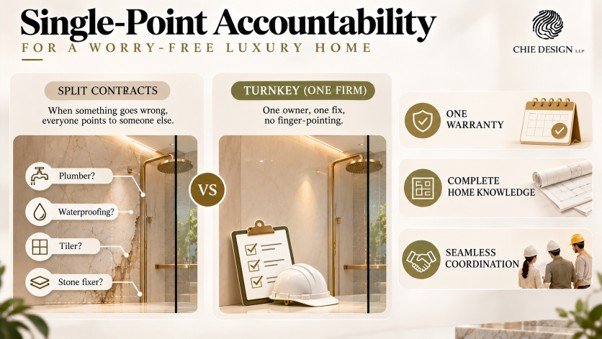
It matters because luxury finishes fail at the joins between trades, not inside them. When one firm owns the whole job, a defect has one owner and one fix. Under split contracts, a cracked stone slab or a damp wardrobe back becomes a negotiation between people who each did “their part” correctly.
Defects that sit between two scopes
Think of a leaking shower that stains Italian marble. Was it the plumber’s joint, the waterproofing layer, the tiler’s slope or the stone fixer’s adhesive? Under conventional contracts, each one can point to the other three. Under turnkey, the firm opens it up and fixes it, then sorts out responsibility internally.
Warranty you can actually use
A turnkey handover typically comes with one defect-liability period covering the whole interior. With separate contractors, you’d hold six informal promises, and half of those vendors may have moved on by the time a hinge sags.
One person who knows the whole home
Two years later, when you want to add a speaker point in the den, a turnkey team has the as-built drawings and knows where every conduit runs. That knowledge is surprisingly valuable, and it usually vanishes with conventional contracting.
How much time do the gaps between contractors really cost?
Coordination gaps commonly add weeks to a luxury fit-out, because every trade waits for the one before it to finish cleanly. Turnkey shortens the programme by overlapping work that can safely run in parallel and by having the next trade’s materials on site before it’s needed.
Delay is already built into Mumbai construction
Delay is normal enough in this market that buyers expect it. An ANAROCK analysis found that MMR and NCR together held 72% of the delayed housing projects across India’s top seven cities. You may already have waited for possession, so an interior programme that slips by another two months hurts twice.
Where the weeks actually go
- Waiting on a measurement: the carpenter can’t make shutters until the stone is fixed and measured.
- Rework after a clash: the AC duct runs exactly where the ceiling designer wanted a recess.
- Material lead times nobody tracked: imported hardware ordered in week ten for a week-twelve install.
- Availability: your painter is on another site the week you finally need them.
What a turnkey programme does differently
A good turnkey team builds a stage-by-stage programme on day one, with each trade’s start date tied to the previous trade’s sign-off. Long-lead items like stone, imported fittings and automation hardware get ordered against approved drawings, not when the site is ready for them.
Does turnkey give you better quality control?
Usually yes, because the people checking the work are paid to deliver the finished result, not one trade’s portion. A turnkey site supervisor inspects each layer before it’s covered up, so problems in waterproofing, conduits and levelling get caught while they’re still cheap to fix.
Inspection before concealment
Most luxury defects start in work you never see again: the slope under a bathroom floor, the gauge of electrical wire, the ply grade inside a wardrobe. A turnkey team photographs and signs off these layers before the next trade covers them.
A single specification
With one firm buying materials, the ply, laminate, edge band, hardware and adhesive come from an approved spec sheet. Under split contracts, each carpenter tends to substitute their preferred brands, and the finish ends up inconsistent room to room.
Snagging that closes
At handover, a turnkey team works through one snag list. With conventional contractors, the list gets split by trade, and the last 5% of items, the ones that bother you daily, often never get closed.
Is turnkey more expensive than hiring contractors separately?
Turnkey usually costs a little more on paper, because the price includes coordination, supervision and the firm’s margin on procurement. In practice, the total often lands close to or below a conventional job once you add the rework, wastage, delays and your own time that split contracting quietly absorbs.
What you pay for in each model
| Cost item | Conventional | Turnkey |
| Design fee | Separate | Included or stated separately |
| Coordination and supervision | Your time, or an extra PMC fee | Included |
| Rework from clashes | Paid by you, usually | Absorbed by the firm |
| Material wastage | Higher, bought piecemeal | Lower, bought against drawings |
| Price certainty | Low, each trade revises | Higher, one priced scope |
The rent and EMI you don’t see
If you’re paying EMI on a new flat while renting another, every month of delay has a real number attached. In a city where Mumbai recorded about 1.5 lakh property registrations in 2025, plenty of families are carrying exactly that double cost while their interiors are being done.
How to compare quotes fairly
Ask both models to price the same drawings and specification. Then add a realistic contingency to the conventional total for rework and delay. For a deeper look at how luxury projects are priced and staged, our guide on how a luxury project in Mumbai is scoped and billed breaks down fee models and payment milestones.
Does turnkey protect the design better?
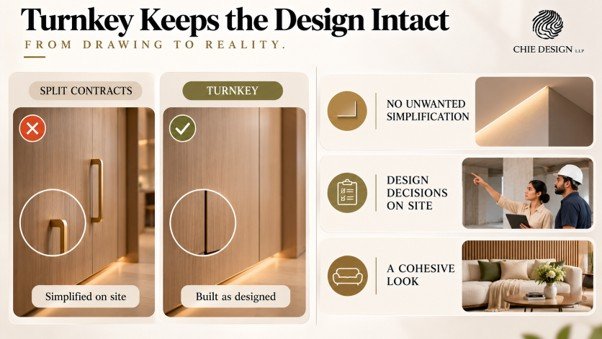
Yes, and for a luxury home that’s often the biggest gain. When the designer and the builder are the same team, the details on the drawing actually get built. With separate contractors, site teams tend to simplify anything unfamiliar, like shadow gaps, flush skirting or concealed doors, and the design loses the very things that made it feel expensive.
The quiet “simplification” problem
A carpenter who has never built a handle-less, push-to-open wardrobe with a 3 mm reveal will often suggest a regular handle. A painter may round off a sharp plaster edge. Each change looks small. Together, they turn a bespoke interior into a standard one.
Design decisions made on site
Sites throw up questions every day: a column that’s 40 mm wider than the drawing, a beam lower than expected. In turnkey, the designer answers on site, in a way that protects the concept. Under split contracts, the contractor on duty answers, usually with whatever is quickest.
Furniture and soft finishes that match
Turnkey teams that also handle loose furniture and furnishing make sure the sofa fabric, the rug and the wall panelling were chosen together. That kind of design and build integration is the core of a design and build service, where one team carries the idea from sketch to styling.
If you’re weighing up the two models for your own home, it’s worth getting a turnkey team to price your drawings alongside your usual contractors. Seeing both on the same scope usually makes the decision for you.
When does conventional contracting still make sense?
Conventional contracting can work for small, single-trade jobs, like repainting a flat, replacing a kitchen countertop or rewiring one room. It also suits homeowners who have time, site experience and a trusted set of vendors. For a full luxury fit-out with imported materials and tight detailing, the coordination load usually outweighs the savings, which is why most homeowners hiring a luxury interior designer for a complete home now ask for turnkey from the start.
Situations where split contracts are fine
- A single trade: painting, polishing or a bathroom fixture swap.
- A refresh, not a rebuild: new soft furnishings and lighting in a finished home.
- An owner who is on site daily: and genuinely enjoys managing trades.
Situations where turnkey is the safer call
- A full gut renovation: civil, services and finishes all change.
- Imported or custom materials: stone, veneers, fittings and automation with long lead times.
- You live elsewhere: NRIs, second homes in Goa, or anyone who can’t visit weekly.
How do you check whether a turnkey offer is genuine?
A genuine turnkey offer gives you one contract, one priced scope tied to drawings, a written programme, a named site lead and a single defect-liability period. If any of those is missing, you’re likely looking at a design firm that subcontracts loosely and passes coordination back to you.
Five things to see in writing
| What to ask for | What a real turnkey team provides |
| Scope | Itemised against drawings and a material spec |
| Programme | Stage-wise dates with sign-off points |
| Site lead | A named supervisor, on site daily |
| Payments | Linked to completed stages, not dates |
| Warranty | One defect-liability period for the whole interior |
Red flags
- “Material by client” on major items: it splits responsibility again.
- No programme until work starts: delay is already being planned in.
- Separate warranties per vendor: that’s conventional contracting with a turnkey label.
Wrapping up
A conventional contractor sells you a trade. A turnkey team sells you an outcome, and on a luxury home that difference is worth more than any per-sq-ft saving. Fewer handoffs, one owner for every defect and a design that survives the site are what you’re really paying for. If you’re comparing options, put both models against the same drawings and see which one you’d rather call when something goes wrong.
Chie Design runs luxury residential and commercial interiors across Mumbai, Pune, Bangalore, Goa and Qatar as a single design-and-build team. The same people who draw the details supervise the site, buy against the approved specification and sign off each stage before the next trade moves in. That’s how bespoke details like flush panelling, concealed storage and layered lighting reach handover intact.
If you’d like your drawings priced as a true turnkey scope, with one contract and one programme, talk to our design team and book a consultation for your home.
FAQs
Is turnkey interior design worth it for a luxury apartment in Mumbai?
Yes, for most full renovations. Luxury apartments involve many trades, imported materials and tight detailing. Turnkey puts all of that under one contract and one schedule, which usually saves time and rework that would otherwise cost you more.
Do turnkey contractors in Mumbai include furniture?
Often, but not always. Some turnkey teams cover civil, services and fixed joinery only, while others include loose furniture, lighting and soft furnishings. Check the scope document line by line before comparing totals between firms.
How long does a turnkey luxury interior project take?
A full luxury apartment fit-out typically takes four to eight months, depending on size, civil changes and material lead times. Imported stone, fittings and automation often decide the timeline more than the site work does.
Can I still choose my own materials in a turnkey project?
Yes. You approve every material on the specification sheet, from stone to hardware. The difference is that the turnkey team then buys, stores and installs them, so responsibility for quality and fit stays with one firm.
Is turnkey always more expensive than separate contractors?
No. Turnkey usually quotes slightly higher on paper, but conventional jobs often absorb hidden costs in rework, wastage and delay. Compare both against the same drawings and add a realistic contingency to the conventional total.
What should a turnkey contract include?
It should include an itemised scope against drawings, a material specification, a stage-wise programme, payment milestones tied to completed work, a named site lead and one defect-liability period covering the entire interior.