
By Chie Design | 10 min read
The modular kitchen cost in India quoted per running foot usually covers only the base and wall cabinet boxes and their shutters. The countertop, sink, hardware upgrades, tall units, appliances, backsplash, lighting, plumbing and electrical changes, installation and tax are typically priced on top, and together they can easily double or triple the number you were first given.
Key insights
- A running foot is a length, not a kitchen: it measures cabinets along the wall and ignores everything above, inside and around them.
- Hardware is where premium kitchens get expensive: pull-outs, lift-ups and corner systems are often extra, item by item.
- Tall units are usually priced differently: pantry and appliance towers are often charged per sq ft, not per running foot.
- The countertop is a separate purchase: stone is priced per sq ft and rarely sits inside the cabinet rate.
Before you go
Ask every supplier for the same thing: a drawing with each unit numbered, and a quote that prices every numbered unit, every accessory and every service line separately. A single per-foot rate times a length is a starting point, not a quote.
Do you know why the kitchen quote you got last month looked so reasonable and the final bill didn’t? It’s because the per running foot rate is a very small part of a kitchen. It prices the cabinets along the wall, and that’s roughly where it stops.
You might not be aware, but on a premium kitchen the items outside that rate can cost as much as the cabinets themselves. The quartz on top, the soft-close drawers that hold your pans, the oven tower, the under-cabinet lights, the new plumbing point for the dishwasher: each of these is a line of its own.
This guide breaks a modular kitchen down the way a designer prices it, so that you can see what the per-foot rate covers, what it leaves out, and what a complete kitchen in a luxury home actually costs.
What does “per running foot” actually measure?
A running foot is one foot of cabinet length measured along the wall. Most suppliers count base and wall cabinets together in that rate, so a 10-foot straight kitchen with cabinets above and below is billed as 10 running feet. However, some suppliers count base and wall units separately, which roughly doubles the footage for the same kitchen.
Base and wall, together or apart
This is the first thing to check, because it changes the comparison completely. It is recommended that you ask, in writing, whether the rate covers base units only, wall units only, or both.
Corners and returns
On an L or U-shaped kitchen, the corner can be counted once or twice depending on the supplier. A U-shaped kitchen with two corners can gain or lose four running feet just from how the corners are measured.
What the rate usually includes
The carcass, the shutters, standard hinges and basic drawer channels are typically inside the rate. The thing to note here is that “standard” hardware in a budget rate is rarely what you’d choose for a luxury kitchen.
| Measurement question | Why it matters | What to ask |
| Base and wall counted together? | Can double the footage | “Is the rate per foot of combined run?” |
| How are corners counted? | Adds or removes feet on L and U layouts | “Show me the footage on the drawing” |
| Which hardware is standard? | Upgrades are priced per piece | “Name the hinge and channel brand” |
| Are tall units in the rate? | Often priced per sq ft instead | “How is the pantry tower priced?” |
How much does a modular kitchen cost in India per running foot?
Indicative 2026 rates run from about ₹2,500 to ₹5,000 per running foot for a basic laminate kitchen, ₹6,000 to ₹12,000 for a good mid-premium specification, and ₹15,000 to ₹30,000 or more for a luxury kitchen with lacquer, veneer or imported fronts. These are ranges, and they move with city, brand and board grade.
What moves the rate within a band
The board, the shutter finish and the hardware brand do most of the work. Moisture-resistant or marine-grade board, acrylic or lacquer shutters, and premium European hardware all push a kitchen up its band.
Why the luxury band is so wide
At the top end, a kitchen may use handle-less profiles, fluted glass, veneer matched across doors, and integrated lighting. Each of these is a choice, and each one adds to the rate.
| Specification band | Indicative rate per running foot | Typical shutter and hardware |
| Basic | ₹2,500 to ₹5,000 | Laminate, standard hinges and channels |
| Mid-premium | ₹6,000 to ₹12,000 | Acrylic or PU, soft-close branded hardware |
| Luxury | ₹15,000 to ₹30,000+ | Lacquer, veneer or imported fronts, premium fittings |
What sits outside the per-foot rate?
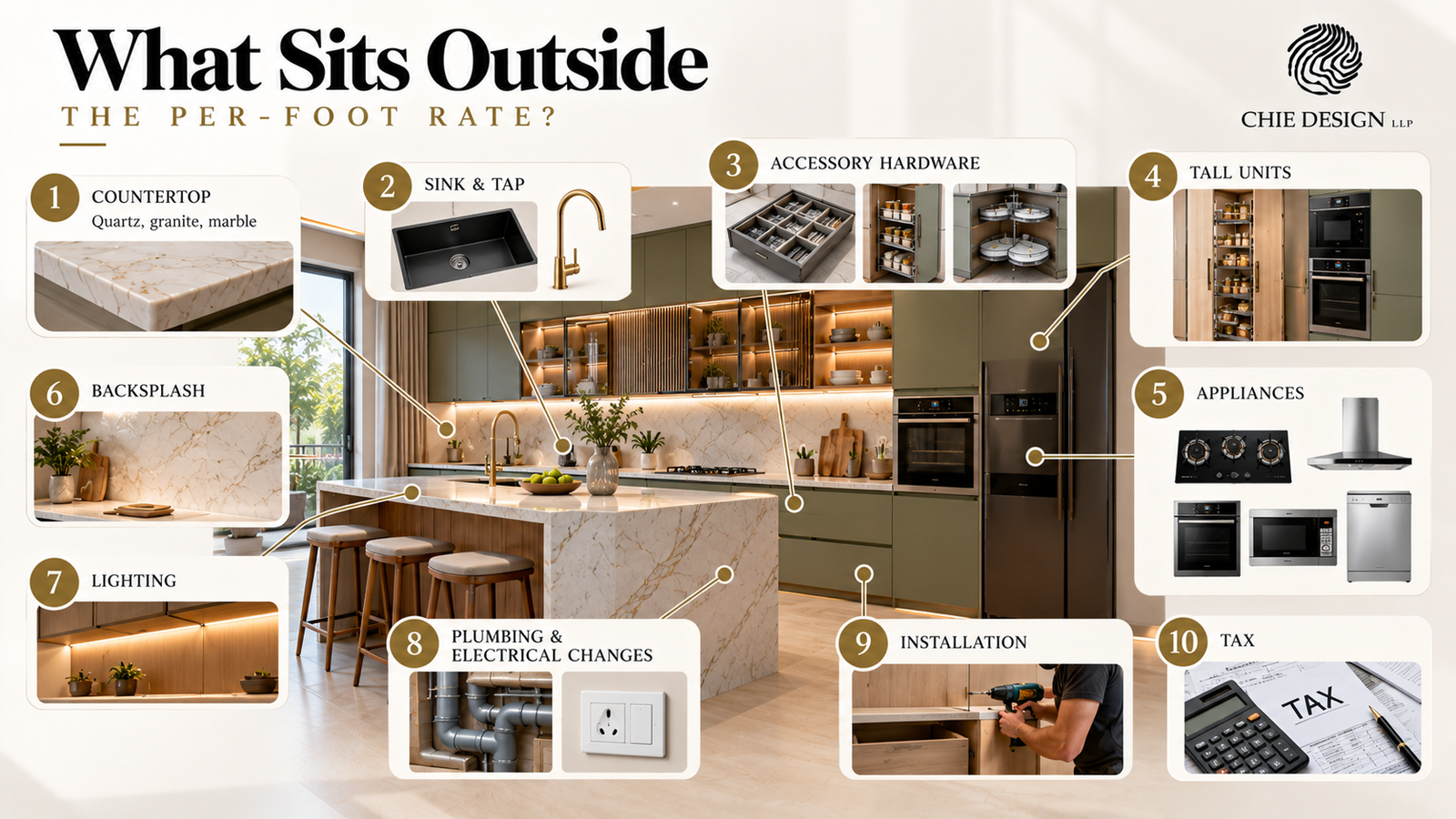
Ten items usually sit outside the per-foot rate: the countertop, the sink and tap, accessory hardware, tall units, appliances, the backsplash, lighting, plumbing and electrical changes, installation, and tax. On a premium kitchen these often cost more than the cabinets themselves.
Countertop
Quartz, granite and marble are priced per sq ft, with edge profiling, cut-outs for the hob and sink, and the backsplash upstand charged extra. A kitchen platform in a large slab of quartz with a waterfall edge can run into lakhs on its own.
Sink and tap
A single-bowl steel sink and a basic mixer may be bundled. However, an undermount granite composite sink and a pull-out mixer almost never are.
Accessory hardware
Tandem drawers, a tall pantry pull-out, corner carousels, lift-up wall units, cutlery organisers and a wicker basket are priced piece by piece. On a luxury kitchen, the accessory list can easily cost ₹2 to ₹5 lakh.
Tall units and appliance towers
Pantry towers, built-in oven and microwave stacks and a refrigerator housing are usually charged per sq ft of front, not per running foot. Moreover, they need heavier hardware, which is priced separately again.
Appliances
The hob, chimney, built-in oven, microwave, dishwasher and wine cooler are almost always excluded, because you pick the brand. The thing to note here is that the cabinets must be designed around the exact appliance model, so the model needs to be fixed before production.
Which services get quietly added to the bill?
Plumbing and electrical changes, under-cabinet lighting, civil work for the backsplash, installation and GST are the services most often added after the first quote. Each one is reasonable on its own, and together they’re the reason the final bill surprises people.
Plumbing and electrical points
A dishwasher, a water purifier, a hob, a chimney, an oven tower and a microwave each need a power point in a specific place. Moving the sink or adding a dishwasher means new plumbing. These are usually charged separately or done by your general contractor.
Lighting
Profile lights under wall units and inside glass shutters make a kitchen usable at night. They need drivers, wiring and sometimes sensors, and they’re often a separate line.
Backsplash and civil work
Tiles, glass or stone on the wall between counter and cabinets are rarely in the kitchen rate. Neither is the civil work to make the wall true before cabinets go up.
Installation, transport and tax
Some suppliers include installation in the rate and some don’t. It is important for you to know whether GST is included in the number you’ve been given, as it changes the total meaningfully.
| Add-on | How it’s usually priced | Easy to miss because |
| Countertop | Per sq ft, plus cut-outs and edges | It looks like part of the kitchen |
| Accessories | Per piece | Shown in renders as if standard |
| Tall units | Per sq ft of front | Different unit from the rest of the quote |
| Appliances | Your choice, separate invoice | You may assume they’re included |
| Plumbing and electrical | Per point or by contractor | Done by a different team |
| Lighting | Per metre or per fixture | Added late, after the design is fixed |
| GST and installation | Percentage or lump sum | Left off “indicative” quotes |
What does a complete luxury kitchen actually cost?
A complete luxury kitchen of about 14 running feet, with tall units, a quartz platform, premium hardware, built-in appliances and lighting, can cost roughly ₹12 to ₹25 lakh or more in total. The cabinets at the per-foot rate are often less than a third of that figure.
A worked example
Take an L-shaped kitchen of 14 running feet at ₹15,000 per foot. The cabinets come to ₹2.1 lakh at the base rate, but by the time a tall pantry and an oven tower, a quartz platform, premium accessories, built-in appliances, lighting, services and tax are added, the total sits several times higher.
| Line | Indicative cost |
| Base and wall cabinets, 14 running feet at ₹15,000 | ₹2.1 lakh |
| Two tall units (pantry and oven tower) | ₹2 to ₹3.5 lakh |
| Quartz platform with cut-outs and upstand | ₹1.5 to ₹3 lakh |
| Accessory hardware | ₹2 to ₹4 lakh |
| Built-in appliances | ₹4 to ₹10 lakh |
| Lighting, plumbing and electrical points | ₹0.5 to ₹1 lakh |
| Installation and tax | Varies with supplier and rate |
So what this means is that the per-foot number is real, but it’s a fraction of the kitchen. A quote that seems ₹3 lakh cheaper often just has fewer of these lines in it.
How should a kitchen be designed before it’s priced?
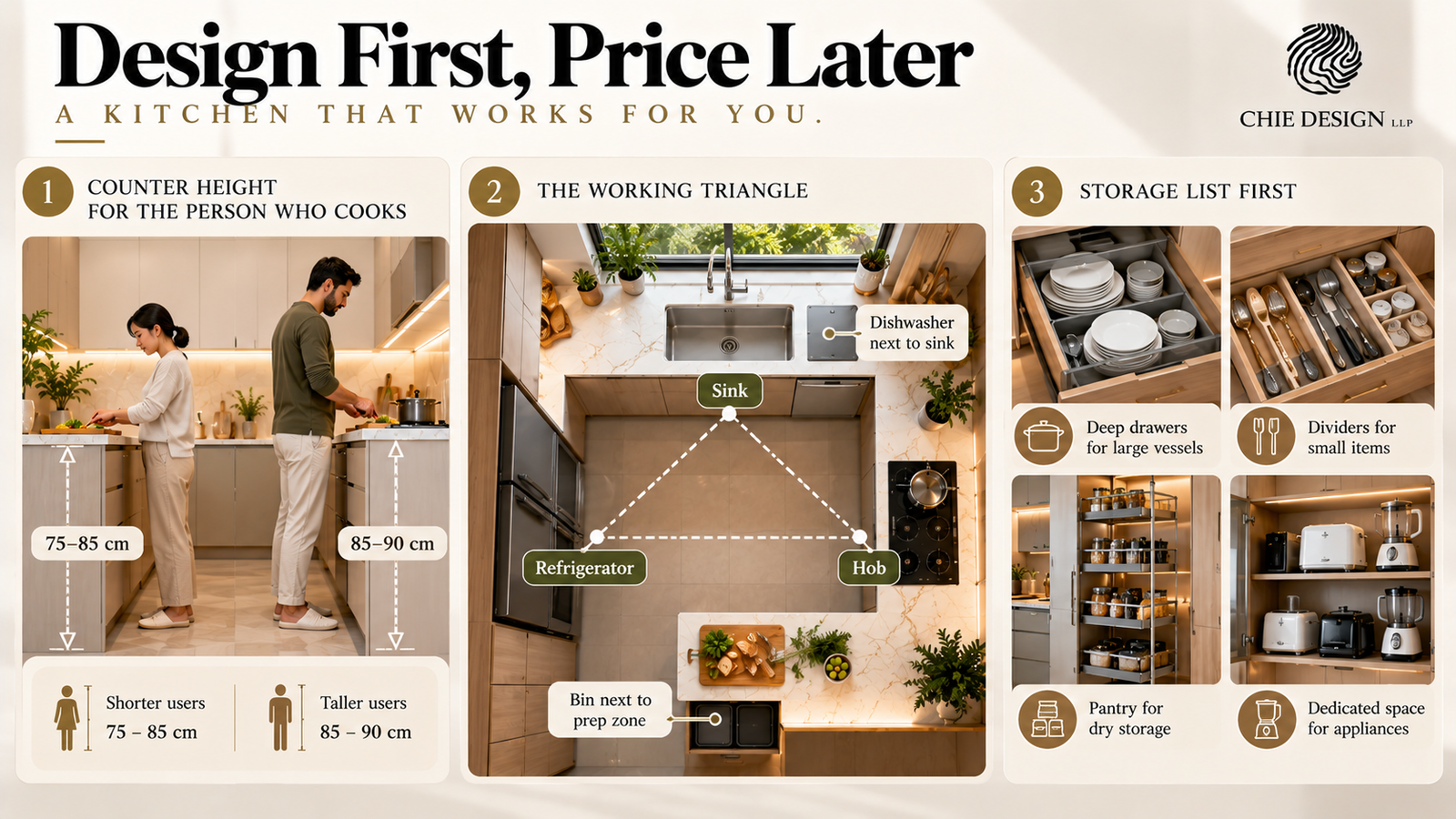
A kitchen should be designed around how you cook and how tall you are before a single rate is applied. The layout, the counter height, the appliance positions and the storage list decide what you’ll buy, and pricing comes after those are fixed.
Counter height for the person who cooks
A standard counter height doesn’t suit everyone. A study of kitchens in Ludhiana found that existing counter heights clustered at 30 to 33 inches regardless of the user’s height, with the biggest mismatches in kneading, rolling and chopping areas. A more recent study of 45 Indian kitchens found that standard countertops of 85 to 91 cm were frequently unsuitable for older users, while multilevel counters of 75 to 90 cm worked better. So what this means is that a kitchen built to your height is worth more than a premium shutter.
The working triangle
The sink, hob and refrigerator should sit close enough to work between without walking around an island. Moreover, the dishwasher should be next to the sink, and the bin next to the prep zone.
Storage list first
Count what you own before choosing accessories. A household that cooks every day with large vessels needs deep drawers, not a corner carousel it’ll never open.
Why does a designed kitchen cost less to get right?
A kitchen designed as part of the whole home avoids the most expensive mistake: rebuilding cabinets because a plumbing point, a beam or an appliance doesn’t fit. That fix usually costs more than the design work that would have prevented it.
Coordination with the rest of the home
Plumbing, electrical points, ceiling heights and flooring all meet in the kitchen. When one team plans them together, the cabinets go in once. Chie Design plans the kitchen as part of its residential interior design work, so the services are drawn before the joinery is made.
A specification you can compare
A designed kitchen comes with a full specification: board, finish, hardware brand, accessory list, countertop and appliances by model. That’s the document that lets you compare two suppliers fairly.
Fewer changes on site
Changes are expensive once production starts. The design process fixes the layout, the appliances and the finishes before anything is cut, which is when changing your mind is still free.
Wrapping up
The per running foot rate is a useful number, but it prices only the boxes on the wall. Before you compare kitchens, ask for a numbered drawing and a quote that prices every unit, every accessory, the countertop, the appliances and every service separately. If you’d like your kitchen planned with the rest of your home, speak to our design team and we’ll walk you through it.
FAQs
What is the cost of a modular kitchen in India per running foot?
Indicative 2026 rates run from about ₹2,500 to ₹5,000 per running foot for a basic kitchen, ₹6,000 to ₹12,000 for mid-premium, and ₹15,000 to ₹30,000 or more for a luxury specification with lacquer, veneer or imported fronts.
Does the per-foot rate include the countertop?
Usually not. Countertops are priced per sq ft of stone, with cut-outs for the sink and hob, edge profiling and the backsplash upstand charged separately. Always ask whether the platform is inside the cabinet rate.
Are appliances included in a modular kitchen quote?
No, appliances are almost always excluded, because you choose the brand and model. The cabinet design must be built around the exact appliance models, so fix them before the kitchen goes into production.
How are tall units priced in a modular kitchen?
Tall units like pantry pull-outs and oven towers are often priced per sq ft of front rather than per running foot. They also need heavier hardware, which is usually priced separately on top.
What is the right kitchen platform height?
The right height depends on the person who cooks most. Standard counters often sit at 85 to 91 cm, which research has found too high for many older and shorter users. Set the height from the main cook’s elbow height.
How much does a luxury modular kitchen cost in total?
A complete luxury kitchen with tall units, a quartz platform, premium hardware, built-in appliances and lighting can cost roughly ₹12 to ₹25 lakh or more. The cabinets alone are often less than a third of that.