
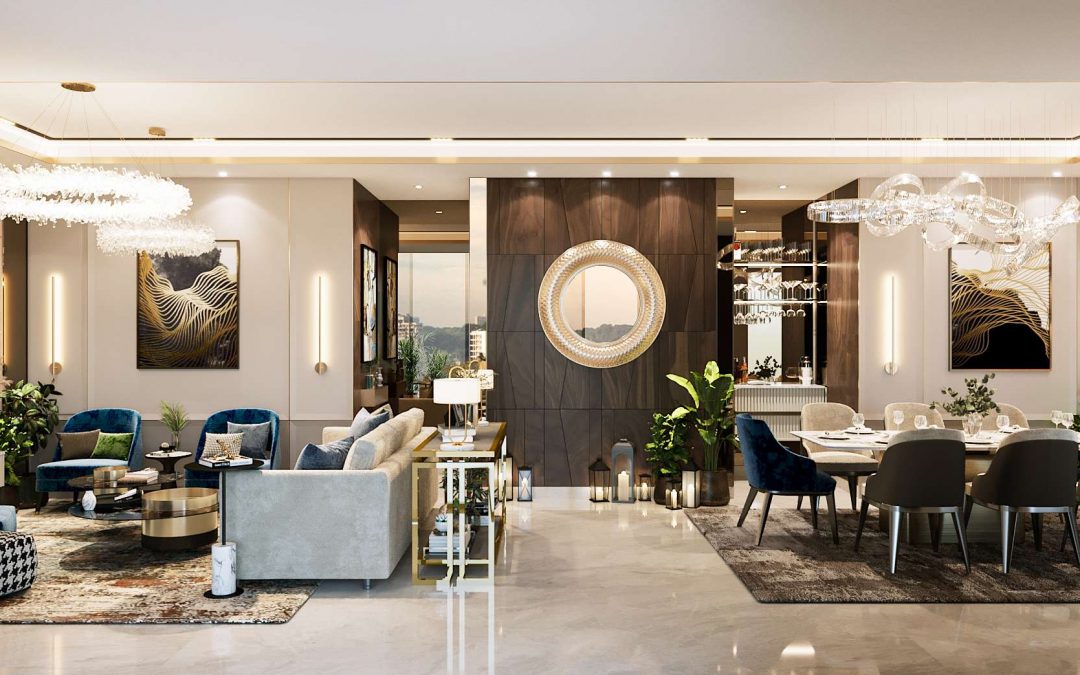
Summary
- Start with furniture placement before adding any partition.
- Use rugs, lighting, and colour to create clear zones.
- Choose dividers that keep light flowing.
- Keep traffic paths open and comfortable.
- Use storage pieces to separate without clutter.
- In Thane homes, compact layouts need flexible zoning.
- Chie Design’s style-led, practical approach suits this kind of planning.
Introduction
Open-plan homes look spacious, but they blur functions. That is why zoning matters. Houzz says open layouts often need furniture changes, rugs, and barriers to define space and reduce noise. It also notes that many homeowners still prefer wall-free, connected layouts.
The challenge is balance. You want one room to feel open, not empty. You want the living and dining areas to feel separate but still connected. That becomes harder in compact homes across Thane, where every square foot must work well.
This guide shows practical ways to separate a living room and dining area without losing light or flow. You will learn which layouts work best, which dividers feel natural, and how to choose the right design support. That is useful whether you are planning a home in Thane or comparing the best home designer in Pune and the top commercial interior designer in Pune.
Why does zoning matter in an open-plan room?
Open-plan rooms work best when each area has a clear role. Without that, the space feels busy and uncertain. Houzz notes that combining living, dining, and cooking zones can be tricky, and the solution often begins with defining the space visually.
Zoning helps you:
- make the room easier to use
- improve movement flow
- reduce visual clutter
- give each area a purpose
- create a calmer look
A living room should invite relaxation. A dining area should feel more focused. When both zones blend too much, the whole room loses identity. That is why designers often begin with function, then add style. Houzz also highlights that open layouts benefit from clear personal boundaries and noise reduction.
For Thane homes, this matters even more. Apartments often have shared living and dining footprints. That means design must create separation without adding bulk. A good layout does that with intention, not extra walls.
Which furniture layout separates the spaces best?
Furniture is the easiest and strongest divider. It does not need construction. It also feels natural in most homes. Houzz recommends orienting furniture to face away from the other zone. It also suggests using a sofa back as a natural divider.
Best furniture choices for zoning
| Furniture piece | Separation level | Best use |
| Sofa placed sideways | High | Creates a soft boundary |
| Console table behind sofa | Medium | Adds structure without blocking light |
| Open shelving unit | High | Separates and stores |
| Sideboard near dining | Medium | Marks the dining zone |
| Accent chairs pair | Medium | Supports a lounge focus |
A sofa is often the most practical divider. It defines the living zone immediately. A console table behind it adds height and elegance. An open shelf works well when you also need storage. Houzz notes that open shelving can divide two areas while still allowing light through.
What layout mistake should you avoid?
Do not push all furniture against the walls. That usually makes the centre feel empty and unclear. Instead, float key pieces slightly inward. This gives both zones shape and makes the room feel designed, not accidental. Houzz’s open-plan advice repeatedly points to furniture orientation as the simplest fix.
How do rugs, lighting, and colour help divide the room?
These are the quickest visual tools. They are also less expensive than building partitions. Houzz says rugs help delineate space and absorb noise. It also points out that lighting and barriers can create more personal boundaries.
Use them in this way
- Place one large rug under the seating area.
- Add a pendant light over the dining table.
- Keep the living zone softer and warmer.
- Use one accent colour in the dining zone.
- Use texture to create subtle contrast.
A rug gives the living room an anchor. A pendant gives the dining table a focal point. Together, they tell the eye where one area ends and the other begins. That is useful in smaller Thane homes, where you may not want a physical divider.
| Design tool | What it does | Best result |
| Rug | Grounds one zone | Clearer visual boundary |
| Pendant light | Marks dining focus | Better atmosphere |
| Colour shift | Separates mood | Subtle distinction |
| Texture change | Adds depth | More layered look |
This approach works especially well in apartments. It keeps the layout open while still making the room feel organised. That is why many designers use these tools before adding anything permanent.
Which dividers work without closing the room?
If the room needs stronger separation, use a divider that still lets light travel. Houzz recommends glass partitions, folding screens, drapery, decorative dividers, and even pony walls. It also notes that glass can add privacy while preserving brightness.
Divider comparison
| Divider type | Privacy | Light flow | Best for |
| Folding screen | Medium | High | Flexible layouts |
| Curtain or drapery | Medium | Medium | Soft separation |
| Open screen | Medium to high | High | Decorative zoning |
| Glass partition | High | High | Bright but structured |
| Pony wall | High | Medium | More defined division |
A glass partition works well when you want structure without a closed feel. A fabric divider feels softer and more relaxed. An open screen is useful when you want movement and flexibility. Houzz also notes that each opening between spaces should remain comfortable for movement, not tight or awkward.
When should you choose a fixed divider?
Choose one when traffic is controlled, the room is large enough, or the dining area needs stronger separation. In smaller homes, keep the divider light. In larger homes, a firmer break can help the room feel more intentional.
How do you keep both areas practical and uncluttered?
A good split should still make daily life easier. NKBA planning guidance stresses clear circulation, functional spacing, and thoughtful room relationships. That applies to open-plan living too, because clutter and blocked paths affect comfort quickly.
Keep these rules in mind
- Leave a clean walking path.
- Keep the dining area close to the kitchen.
- Let natural light reach both zones.
- Avoid oversize furniture.
- Use storage pieces that serve two roles.
A sideboard can store dining items and also act as a boundary. A slim cabinet can do the same. That is useful in Thane apartments, where storage and separation need to work together. Houzz also shows that design professionals often solve open-plan issues by balancing layout, noise, and visual privacy.
How can design support this better?
Chie Design’s site describes its work as stylish, refined, tasteful, and elegant. It also emphasises intelligent, high-performance design and careful implementation across residential and commercial projects. That is the kind of thinking that helps open-plan spaces feel deliberate.
If you are comparing the best home designer in Pune or the top commercial interior designer in Pune, ask how they handle zoning, storage, and flow. Those three details separate good styling from good planning. Chie Design’s residential and commercial pages show a strong focus on practical, client-specific layouts.
Contextual CTA: If you are planning an open-plan home in Thane, Chie Design can help create a layout that feels elegant, practical, and well-zoned.
What should you ask before choosing a design solution?
Before you commit, ask four simple questions. Does this improve flow? Does it keep the room bright? Does it fit my furniture? Does it match how my family uses the space? Those questions keep the design practical.
Pros and cons of common solutions
| Solution | Pros | Cons |
| Furniture zoning | Low cost, flexible | Needs careful placement |
| Rugs and lighting | Fast and subtle | Less physical separation |
| Open shelving | Adds storage | Can feel visually busy |
| Glass partition | Bright and defined | Higher cost |
| Fixed wall | Strong separation | Can reduce openness |
For many homes, the smartest answer is layered. Start with furniture. Then add rugs and lighting. Use a divider only if the room still feels too open. That approach keeps the home usable and easy to update later.
Frequently asked questions
What is the easiest way to separate a living room and dining area?
Use furniture first. A sofa, console table, and rug can define both spaces without making the room feel smaller. Houzz recommends orienting furniture as the first step.
Do I need a wall to separate open-plan spaces?
No. Many homes work better without one. Houzz notes that wall-free layouts are still popular, and lighter zoning methods often give better flexibility.
Which divider works best in a small apartment?
Open shelving, a sofa back, or a glass partition usually work best. They divide the room without blocking light or making the space feel cramped.
How do I keep the room from looking crowded?
Use fewer large pieces, keep walkways clear, and choose lighter dividers. NKBA guidance also supports clear circulation and functional spacing.
How do I know if a designer is the right fit?
Ask whether they can explain zoning, storage, lighting, and flow in simple terms. Chie Design’s site highlights personalised, high-performance design across home and commercial projects.
Conclusion
The best way to separate a living room and dining area is to combine furniture, visual cues, and smart dividers. That gives you structure without losing the openness that makes the room feel inviting. Houzz and NKBA both support this practical, flow-first approach.
For homes in Thane, this matters even more. Compact open-plan layouts need balance, not clutter. The right solution should feel calm, flexible, and easy to live with. Chie Design’s residential and commercial approach fits that kind of thoughtful planning.
If you are comparing the best home designer in Pune or the top commercial interior designer in Pune, look for a team that understands zoning as well as style. That is where a room starts working better, not just looking better.
Talk to Chie Design today and plan an open-plan space that feels beautifully separated and easy to use.