
By Chie Design | Reviewed by Mithila S., Founder and Principal | 10 min read
A full home interior costs roughly ₹8 to ₹18 lakh for a 2BHK and ₹12 to ₹28 lakh for a 3BHK in Bangalore, and typically lands 10 to 20 per cent lower in Pune for comparable scope and finish. The gap is real but smaller than most people assume, and it narrows to almost nothing once you move into premium materials, because the finishes themselves are priced nationally rather than locally.
Key insights
- Pune runs 10 to 20 per cent cheaper, and only on part of the bill: the saving sits in labour, not in materials.
- Only three things genuinely differ between the cities: labour rates, modular market depth and average layout size.
- Kitchen and wardrobes are close to half the budget in both cities, which is where a comparison should start.
- Most city gaps are scope gaps in disguise: two quotes rarely describe the same house.
Chie Design expert tipMithila S., Founder and Principal, Chie Design: “Price the kitchen and the wardrobes on their own, in writing, before anyone gives you a total. Those two lines carry nearly half the budget and all of the ambiguity. Once they are fixed, the rest of the home is a comparatively honest number.” |
Anyone comparing quotes from a top interior designer in Pune against one from a best interior designer in Bangalore usually finds the two numbers unhelpfully far apart. That is rarely a city effect. It is almost always a scope effect wearing a city’s clothes.
This piece separates the two, so you can see which part of a quote is genuinely about where you live and which part is about what you are buying.
What does a full home interior actually cost in each city?
Both cities price full home interiors on carpet area, finish level and how much carpentry the home needs. Bangalore sits slightly higher across the board, driven by modular kitchen and wardrobe demand and a more competitive premium segment. Pune runs lower on labour and slightly higher on volume, because Pune layouts tend to be larger for the same budget.
Range by home size
| Home size | Bangalore range | Pune range | Where the gap comes from |
| 1 BHK | ₹5 to ₹9 lakh | ₹4 to ₹8 lakh | Labour rates |
| 2 BHK | ₹8 to ₹18 lakh | ₹7 to ₹15 lakh | Labour, modular pricing |
| 3 BHK | ₹12 to ₹28 lakh | ₹10 to ₹24 lakh | Carpentry volume |
| 4 BHK and villas | ₹25 lakh upward | ₹22 lakh upward | Near parity at this level |
What the published city guides say
Published Bangalore guides put a 2BHK full home interior in the ₹11 to ₹19 lakh band and a 3BHK at ₹16 to ₹28 lakh depending on scope and material choice, which is broadly where established design-and-build firms quote.
Pune guides run lower at the entry point. Cost breakdowns for the city put basic 2BHK interiors covering kitchen, wardrobes and TV units in the ₹3.5 to ₹5 lakh range, with premium versions of the same scope reaching ₹5 to ₹7 lakh, before the rest of the home is added.
Read those two carefully, because they are not measuring the same thing. One is a whole-home number and the other is a three-element number, and this is exactly how two quotes end up looking like a city difference when they are actually a scope difference.
Finish level, which moves the number more than the city does
| Finish level | What it means in practice | Effect on a 3BHK budget |
| Essential | Laminate shutters, standard hardware, minimal ceiling work | Bottom of the range |
| Mid | HDHMR or plywood cores, branded hinges and channels, considered lighting | Middle of the range |
| Premium | Veneer and acrylic finishes, engineered stone, imported hardware | Top of the range and beyond |
Moving one step up this table costs more than moving cities. That is the single most useful thing to understand before comparing anything.
Where the two cities genuinely differ
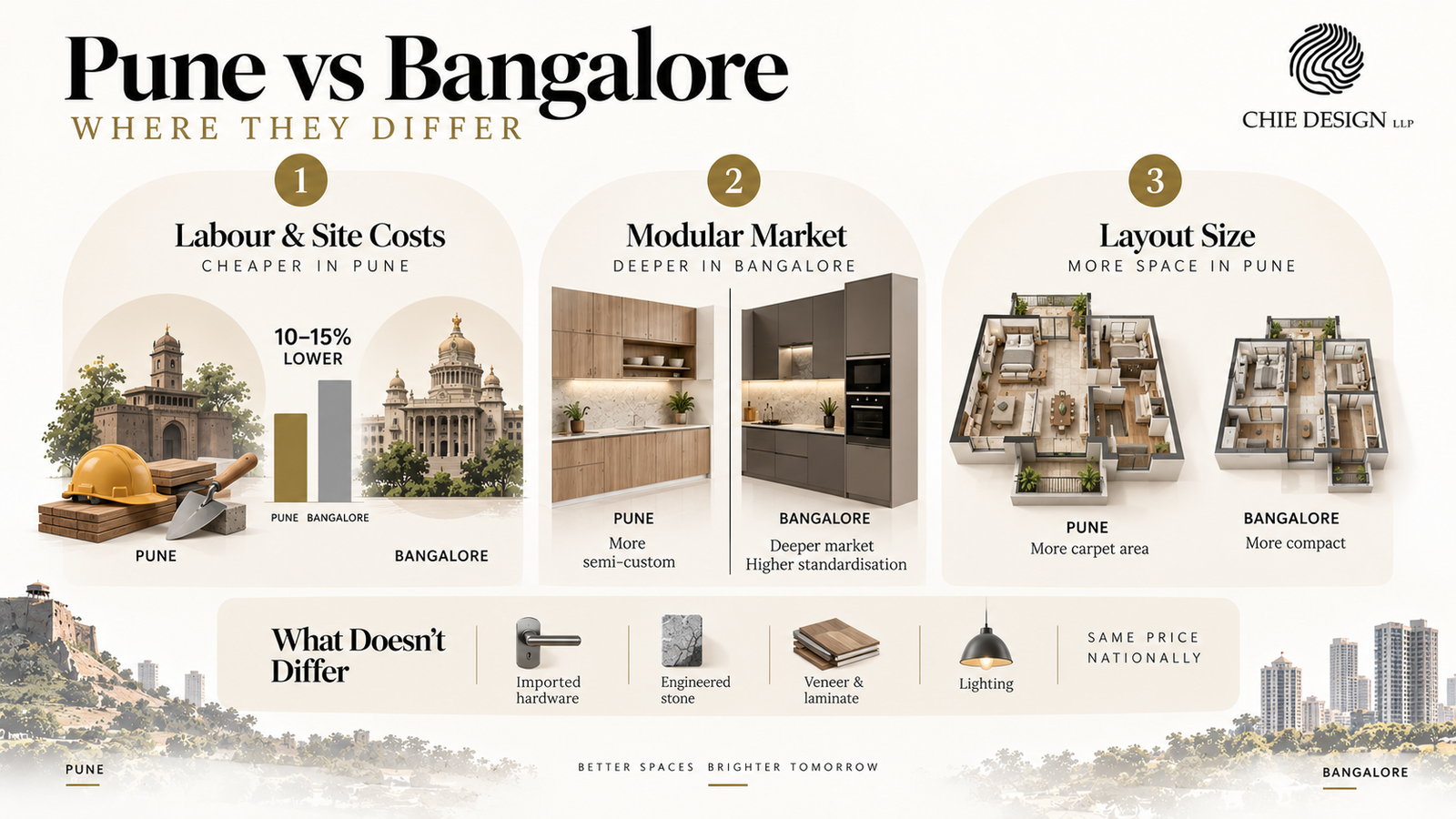
Three things, and only three, move meaningfully between Pune and Bangalore.
Labour and site costs
Skilled carpentry and civil labour are cheaper in Pune, typically by 10 to 15 per cent. On a project where carpentry is 40 per cent of the budget, that is a real saving.
Modular pricing and market depth
Bangalore’s modular kitchen and wardrobe market is deeper and more standardised, which pushes quality up and sometimes pushes price up with it. Pune buyers more often go semi-custom.
Layout size
Pune apartments tend to give more carpet area for the same money. That is good news for living, and mildly bad news for budgets, because more area means more flooring, more false ceiling and more wardrobe running feet.
What does not differ
Notice what is not on that list. Imported hardware, engineered stone, veneer, laminate and lighting are priced nationally. A ₹4,000 per square metre stone costs the same in Kothrud as in Koramangala, plus freight.
How the budget splits inside the number
Roughly half of a full home interior budget goes into two rooms. Kitchens and wardrobes dominate every quote in both cities, which is why a home with an existing usable kitchen costs dramatically less to do than one starting bare.
| Line item | Share of total | Notes |
| Kitchen | 20 to 28 per cent | Appliances often priced separately |
| Wardrobes and storage | 18 to 25 per cent | Driven by running feet, not room count |
| False ceiling, electrical and lighting | 12 to 18 per cent | Creeps as the lighting plan matures |
| Flooring and civil work | 10 to 20 per cent | Depends entirely on whether you change it |
| Loose furniture and soft furnishing | 10 to 15 per cent | Easiest line to stage over time |
| Design fee and project management | 8 to 15 per cent | Check whether it is inside or outside the total |
Two of those lines are where people overspend without meaning to. Kitchens creep because appliances get upgraded one at a time, and false ceilings creep because lighting layouts get more ambitious as the design develops.
A sample allocation for a mid-range 3BHK
Taking a ₹18 lakh Bangalore 3BHK at mid finish level, the split lands roughly here.
| Item | Indicative allocation |
| Kitchen including counter | ₹4.2 lakh |
| Wardrobes across three bedrooms | ₹3.8 lakh |
| False ceiling, electrical and lighting | ₹2.7 lakh |
| Flooring and civil rework | ₹2.4 lakh |
| Loose furniture and furnishing | ₹2.2 lakh |
| Design fee and project management | ₹2.0 lakh |
| Contingency held back | ₹0.7 lakh |
The same house in Pune at the same specification lands closer to ₹15.5 lakh, and almost the entire difference sits in the first two rows and the civil line.
Hidden costs most people leave out of the comparison
- Society deposits and permissions: refundable, but they are cash out at the start in both cities.
- Debris removal and material hoisting: significant in tower buildings with a single service lift.
- Appliance packages: frequently specified by the designer and bought directly by you.
- Electrical rework in older buildings: rarely visible until walls open.
- Post-approval changes: the most expensive rupee in any project is the one spent after carpentry release.
- GST: confirm whether the quoted total is inclusive, since on a full home it moves the number materially.
Modular or fully custom, and what it costs you
| Approach | Cost position | Best when |
| Modular | Predictable, faster, mid to premium | Standard layouts, tight timelines |
| Semi-custom | Between the two | Odd corners in an otherwise regular flat |
| Fully custom carpentry | Higher, slower, no ceiling on finish | Unusual layouts, specific material intent |
Pune projects skew semi-custom, Bangalore projects skew modular, and that alone explains part of the price gap people attribute to the city.
Ways to bring the number down without gutting the specification
- Keep the existing kitchen layout even if you change everything in it, because moving plumbing and gas is disproportionately expensive.
- Reduce wardrobe running feet rather than downgrading wardrobe material.
- Stage the loose furniture over two phases, since it is the only line that does not disrupt the site later.
- Simplify the false ceiling and put the saving into the lighting instead, which is what you actually notice.
- Fix the drawings before release because every change after that is priced as rework rather than as work.
Which city should you finish first?
If you own homes in both, do the one you will live in soonest, and do it in the city where you can actually be present for the decision-heavy weeks. Distance costs more than a labour differential.
That has become a common question rather than an unusual one, because a large number of buyers in both cities are managing property remotely. A design team already working across both cities removes the version of this problem where two separate firms produce two different homes for the same family.
Full-home budgets for either city are best set against a room-by-room estimate rather than a per-square-foot average. Our interior designer in Pune and interior designer in Bangalore pages set out how projects are scoped in each city.
What makes one quote higher than another in the same city
Scope, almost always. Two quotes in the same city for the same flat diverge for reasons that have nothing to do with location.
The common ones are civil work included versus excluded, loose furniture included versus excluded, core material in carpentry, whether the kitchen appliance package is priced in, and whether the number covers project management or leaves you coordinating vendors.
Ask each firm for the same room list, the same finish level and the same inclusions. Then, and only then, is the cheaper number actually cheaper.
Wrapping up
Pune is cheaper than Bangalore, by roughly the amount that labour is cheaper and no more. Everything else in the gap between two quotes is scope, finish level or carpentry volume. Fix those three variables first, compare second, and the city question turns out to be the least interesting part of the decision.
Chie Design works across both cities and quotes room by room rather than on a per-square-foot average, which is what makes a Pune and a Bangalore estimate genuinely comparable. The same team, the same specification format, and a single point of accountability mean the difference you see between two cities is the actual difference rather than an artefact of two firms describing scope differently.
If you are weighing up a home in either city, ask for a room-level estimate at a defined finish level before comparing anything. Talk to Chie Design about your project and get a breakdown you can hold two quotes against.
FAQs
Is interior design cheaper in Pune than Bangalore?
Generally yes, by around 10 to 20 per cent for comparable scope, driven mainly by lower labour costs. The gap narrows significantly at premium finish levels, since materials and imported hardware are priced nationally rather than by city.
What does a 2BHK full home interior cost in Bangalore?
Typically ₹8 to ₹18 lakh depending on finish level, carpentry volume and whether civil work is included. Published city guides place the range slightly higher at ₹11 to ₹19 lakh for a complete scope with mid to premium materials.
What is the biggest cost item in a full home interior?
The kitchen, usually 20 to 28 per cent of the total, followed by wardrobes and storage at 18 to 25 per cent. Together they routinely account for close to half of a full home interior budget in either city.
Should I budget per square foot or room by room?
Room by room. Per-square-foot averages hide enormous variation in carpentry volume and finish level, and two homes of identical area can differ by 60 per cent in cost depending on how much built-in storage each one needs.
How much contingency should I keep?
Hold 10 to 15 per cent of the total for site conditions you cannot see yet, particularly in older buildings where plumbing and electrical rework tends to surface only once work begins.
Does a premium finish cost the same in both cities?
Broadly yes. Veneer, acrylic, engineered stone and imported hardware are nationally priced, so a premium specification narrows the Pune advantage to the labour component alone.