
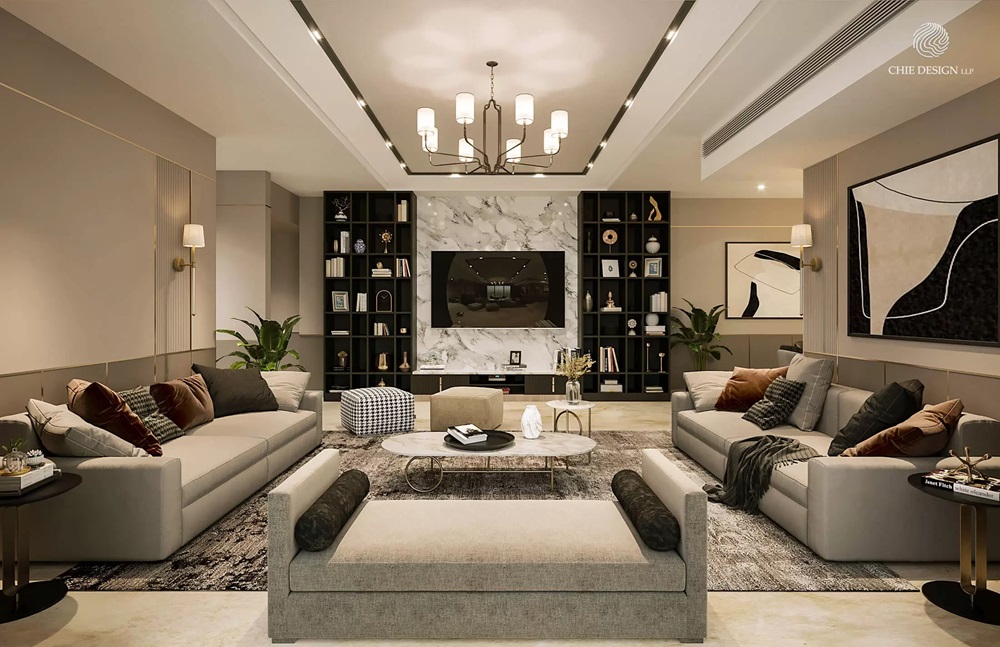
By Chie Design | 10 min read
In the veneer vs laminate choice, premium veneer wins on depth, warmth and the look of real timber, while matte laminate wins on scratch resistance, colour consistency and easy care. For a luxury home, the best answer is usually both: veneer on the surfaces people see and touch slowly, laminate where surfaces work hard every day.
Key insights
- Veneer is real wood: a thin slice of timber, so every sheet’s grain is different and it can be refinished years later.
- Laminate is engineered: paper and resin pressed under heat and pressure, so it’s tough, uniform and almost maintenance-free.
- Matte laminate has changed: new super-matte and anti-fingerprint surfaces now look far less “plastic” than older gloss sheets.
- Mixing is the luxury move: veneer for the feature wall and wardrobe fronts, laminate for kitchen carcasses and kids’ rooms.
Ask for this
Before you approve any veneer, ask to see the actual flitch, or at least three sheets from the same log, laid side by side. Grain varies so much that a 6-inch sample tells you almost nothing about how a full wardrobe wall will look.
Picture two wardrobe walls in the same flat. One is book-matched American walnut veneer, the grain mirrored across each pair of shutters so the whole wall reads like one opened slab of wood. The other is a charcoal super-matte laminate with a soft-touch surface, flush handles and not a single fingerprint. Both look expensive. Both are right. They just suit very different rooms and very different people.
That’s why the question comes up in almost every first meeting with homeowners in Pune and Bangalore. It’s rarely “which is better?” It’s “which is better for this wall, in this home, for how we live?”
This guide covers what each material actually is, its real pros and cons, how they compare on cost and care, and a room-by-room map of where each one earns its place.
[Image] a split detail shot of a wardrobe, left half in book-matched walnut veneer, right half in charcoal super-matte laminate, with a hand touching the seam. Caption: Real grain on one side, engineered calm on the other; most luxury homes use both.
What is the difference between veneer and laminate?
Veneer is a thin sheet of real wood sliced from a log and bonded to plywood or MDF. Laminate is a manufactured sheet made by pressing resin-soaked paper layers with a printed or solid decorative layer on top. One is natural and unique; the other is engineered and repeatable.
How veneer is made
Natural veneer is sliced or peeled from a log into very thin leaves. One European manufacturer describes it as a thin sheet of hardwood, usually thinner than 3 mm. Those leaves are stacked in the order they came off the log, which is how designers book-match or slip-match the grain.
How laminate is made
High-pressure laminate starts with layers of kraft paper saturated in phenolic resin, topped with a décor paper. According to the Composite Panel Association, the stack is fused under heat and pressure of over 1,000 PSI, which cures the resin into a hard, sealed surface.
What “matte” means today
Older laminates were mostly gloss or suede. Today’s premium range includes super-matte, soft-touch and anti-fingerprint surfaces, some with a slight texture that diffuses light. This is the main reason laminate has moved back into luxury homes.
| Feature | Premium veneer | Matte laminate |
| Material | Real wood slice | Paper and resin, engineered |
| Look | Unique grain, depth, warmth | Uniform colour or print |
| Touch | Natural, slightly open grain | Smooth, soft or lightly textured |
| Durability | Moderate, needs polish | High, scratch and stain resistant |
| Repairable | Yes, can be sanded and re-polished | Limited, damaged sheets are replaced |
What are the pros and cons of premium veneer?
Premium veneer gives you real timber character, depth under light and a finish that can be repaired and refreshed. Its downsides are higher cost, sensitivity to moisture and sunlight, more skilled installation and a polish that needs looking after.
Pros of veneer
- It’s genuine wood: guests can see and feel that it’s timber, which no print fully copies.
- Every wall is one of a kind: no two flitches are identical.
- Matching creates drama: book-matched or sequence-matched panels make a wall read as one surface.
- It ages and can be renewed: a tired veneer can be sanded lightly and re-polished.
- Stain and polish control the mood: the same oak can go pale Scandinavian or deep smoked.
Cons of veneer
- Moisture and sun: veneer near wet areas or strong west sun can lift, fade or change colour.
- It needs a skilled polisher: PU or melamine polish quality decides the final look.
- Higher cost: both the material and the labour cost more than laminate.
- Natural variation: if you want every shutter to look identical, veneer will frustrate you.
Where veneer shines
Living-room panelling, TV walls, bedroom headboards, master wardrobe fronts, study shelving and entrance foyers. These are surfaces people look at closely and touch gently, which is exactly where real wood pays off.
What are the pros and cons of matte laminate?
Matte laminate gives you a tough, consistent, low-maintenance surface in almost any colour, at a lower cost than veneer. Its downsides are that it can’t be refinished, edges need careful banding, and printed woodgrain still reads as a print up close.
Pros of matte laminate
- Hard-wearing: resists scratches, stains, heat marks and everyday knocks.
- Uniform: every shutter matches, which suits minimal, handle-less designs.
- Easy to clean: a damp cloth is enough, and anti-fingerprint versions hide smudges.
- Wide palette: solid colours, stone looks, fabrics and metallic effects.
- Faster to install: no on-site polishing, so less dust and fewer days.
Cons of matte laminate
- No refinishing: a deep gouge means replacing the sheet or the shutter.
- Visible edges: a poor edge band or a dark core line spoils the look.
- Woodgrain prints repeat: across a large wall, a trained eye spots the pattern.
- Some matte surfaces mark: cheaper matte sheets can burnish shiny where they’re touched often.
Where laminate shines
Kitchen shutters and carcasses, utility rooms, kids’ bedrooms, wardrobe interiors, home offices and anywhere near water. Anywhere the surface is opened, wiped and bumped many times a day.
How do veneer and laminate compare on cost and care?
Premium veneer, including polish and installation, typically costs noticeably more per square foot than premium matte laminate, and it needs periodic care. Laminate costs less, installs faster and needs almost no maintenance, which is why most homes use it for high-use areas even when budgets are generous.
Indicative cost comparison
| Item | Premium veneer | Premium matte laminate |
| Material cost | Higher, varies widely by species | Lower, varies by brand and finish |
| Labour | Higher, needs polishing on site | Lower, pressed and edge-banded |
| Install time | Longer, polish needs curing | Shorter |
| Long-term care | Re-polish every few years in busy areas | Wipe clean, little else |
Figures depend heavily on species, brand and polish system. Exotic veneers like walnut or smoked eucalyptus cost several times more than teak or oak, and premium imported laminates can cost more than basic veneer.
Caring for veneer
Keep it out of direct afternoon sun where you can, wipe with a dry or barely damp cloth, and avoid harsh cleaners. Felt pads under décor and a little attention to humidity during the monsoon make a big difference.
Caring for matte laminate
Use a soft cloth and mild soap. Avoid abrasive pads, which can polish matte surfaces into shiny patches. For the soft-touch finishes, check the manufacturer’s cleaning guidance, because some solvents can damage the top layer.
[Image] a luxury kitchen with charcoal super-matte laminate shutters beside a tall walnut-veneer pantry unit, soft daylight from the side. Caption: Laminate where the work happens, veneer where the eye rests.
Which finish works best in each room?
Use veneer where the surface is a design statement and laminate where it does daily work. In most luxury homes that means veneer in living and master bedroom spaces, laminate in kitchens, utility and children’s rooms, and a mix in wardrobes: veneer outside, laminate inside.
A room-by-room map
| Room or element | Our usual pick | Why |
| Living room panelling and TV wall | Veneer | Seen up close, rarely knocked |
| Foyer and entrance console | Veneer | First impression of the home |
| Master wardrobe fronts | Veneer or mix | Gentle use, high visual impact |
| Wardrobe interiors | Laminate | Constant friction from hangers and boxes |
| Kitchen shutters | Matte laminate | Grease, steam, heavy daily use |
| Kids’ rooms | Matte laminate | Scratches, crayons, stickers |
| Home office | Either | Laminate for desks, veneer for shelving |
| Utility and bathrooms vanity | Laminate | Water and detergents |
The hybrid wardrobe
The most common luxury solution is a veneer outer shutter with a laminated inner face and laminate-lined carcasses. You get real wood where it’s seen and a wipe-clean, hard-wearing surface where clothes and hangers rub every day.
Matching across rooms
When veneer and laminate sit next to each other, pick laminate in a tone that picks up a colour inside the veneer grain, not one that tries to imitate it. A walnut veneer next to a warm taupe matte reads intentional. Walnut next to a walnut print reads like a cost cut.
How does climate in Pune, Bangalore and coastal cities change the choice?
Climate changes how much risk veneer carries. Drier, milder cities like Pune and Bangalore are kind to veneer, while humid coastal cities like Mumbai and Goa push you towards laminate near any moisture and better-sealed veneer everywhere else.
Pune and Bangalore
Both cities have moderate humidity for most of the year, so veneer behaves well indoors. Homeowners looking for the top interior designer in Pune or the best interior designer in Bangalore often have more freedom to use veneer widely, including in dining and study spaces.
Mumbai and Goa
Long, humid monsoons mean veneer needs a good sealing polish on all faces, not just the visible one, and it should stay well away from wet zones. Laminate is the sensible pick for kitchens, utility areas and anything near a balcony door.
A tip for every city
Whatever the climate, balance both sides of a panel. A veneered front with a bare back can bow as it absorbs moisture unevenly. A matching balancing laminate or veneer on the inside face keeps shutters flat for years.
How do you choose between the two for your home?
Start with how you live, not the material. List each surface, ask how often it’s touched, wiped or knocked, and how close people stand to it. Hard-working surfaces go to laminate; slow, admired surfaces go to veneer. Then check the budget and climate, and adjust.
Questions to ask yourself
- Who uses this room? Children, pets and frequent guests favour laminate.
- How close do people look? A feature wall seen from a sofa deserves veneer.
- How much upkeep will you do? If the answer is “none”, lean laminate.
- What’s the light like? Strong west sun can fade veneer over time.
Questions to ask your designer
- Can I see full sheets of the veneer, not just a chip?
- What polish system do you use, and how many coats?
- Which laminate brand and edge band are specified?
- Will both faces of every panel be balanced?
If you’d like a second opinion on your finish schedule, ask your designer to walk you through it room by room. A good team will explain every choice in terms of use, not just looks.
Wrapping up
There’s no winner in veneer vs laminate, only the right finish in the right place. Veneer brings the warmth, depth and uniqueness that make a home feel crafted. Matte laminate brings the toughness that keeps it looking new. A well-planned luxury interior uses both on purpose.
Chie Design specifies and builds fixed woodwork for luxury residential interiors across Pune, Bangalore, Mumbai and Goa, matching each surface to how it will be used. If you’re planning your joinery now, talk to our team and book a consultation to walk through your finish schedule.
FAQs
Is veneer better than laminate for a luxury home?
Not always. Veneer is better for statement surfaces like TV walls and wardrobe fronts because it’s real wood. Laminate is better for kitchens, kids’ rooms and wardrobe interiors because it resists scratches, stains and moisture.
Does veneer last as long as laminate?
Yes, if it’s cared for. Good veneer with a quality polish can last decades and can be sanded and re-polished. Laminate lasts well too but can’t be refinished, so damaged sheets need replacing.
Is matte laminate hard to clean?
No. Matte laminate cleans easily with a soft cloth and mild soap. Avoid abrasive scrubbers, which can create shiny patches. Anti-fingerprint versions are the easiest to keep spotless in kitchens and wardrobes.
Can I use veneer in a kitchen?
You can, but it’s risky. Steam, grease and frequent wiping wear veneer faster than laminate. If you love wood in the kitchen, use veneer on a tall unit or open shelf away from the hob and sink.
Why does my veneer wardrobe look different from the sample?
Because veneer is natural. Grain and colour vary from log to log and even sheet to sheet. Ask to see full sheets from the same batch before approval, so the wall you get matches the look you expect.
What is book-matched veneer?
Book-matching places consecutive veneer leaves side by side like an open book, so the grain mirrors across each joint. It creates a symmetrical, continuous pattern and is popular for feature walls and wardrobe fronts.