

By Chie Design | Reviewed by Mithila S., Founder and Principal | 10 min read
Luxury interior projects in Mumbai are billed one of three ways: a percentage of project cost, usually 8 to 15 per cent, a per-square-foot design fee, or a fixed lump sum against a defined scope. Payment is released in stages tied to milestones rather than dates, and a meaningful list of items sits outside almost every quote by convention rather than by concealment.
Key insights
- Three fee models, and the right one depends on how much is still undecided, not on how large the budget is.
- Milestone payments protect you, calendar payments do not: a payment tied to week eight buys time rather than progress.
- Every quote has exclusions, and a studio that hands you the list with numbers against it is doing the job properly.
- Hold a retention of 5 to 10 per cent until the snag list is closed, because it is the only real lever you keep at the end.
Chie Design expert tipMithila S., Founder and Principal, Chie Design: “Ask for the exclusions list before you ask for the total. Two proposals are only comparable once you know what each one has decided not to include, and that page tells you more about a studio than the fee percentage does.” |
That last point causes most of the friction. A client reads an exclusion as something hidden. A studio reads it as something unknowable at quoting stage. Both are partly right, and the fix is simply seeing the list before signing.
This is how luxury interior designers structure commercials in Mumbai, what each model suits, and the specific line items worth asking about before a contract is drawn.
Which fee model applies to your project?

Mumbai studios use different models depending on how defined the scope is at the outset, and the right one depends less on budget than on how much is still undecided.
Percentage of project cost
This works when the scope will evolve. The fee scales with the work, which aligns the studio with the eventual size of the project but requires trust that the scope is not being inflated. Indian design fees in this model commonly sit in a 6 to 15 per cent band of total project cost, varying with the studio’s standing and the complexity involved.
Per square foot
This works when the area is fixed and the finish level is agreed. It is the easiest model to compare across studios and the least forgiving of a client who changes direction.
Lump sum against defined scope
This works when drawings and specifications already exist. It transfers risk to the studio, which prices that risk in, so it is rarely the cheapest headline number.
How the three compare
| Model | Best when | Watch for |
| Percentage of cost | Scope still evolving | Scope creep raising the fee base |
| Per square foot | Area and finish fixed | Change requests billed separately |
| Lump sum | Drawings already exist | Risk premium in the headline number |
| Design plus execution (turnkey) | You want single accountability | Confirm design fee is not double-counted |
For high-value residential work in South Mumbai and the western suburbs, percentage-based fees remain the norm, largely because bespoke joinery, imported stone and custom furniture make the final scope genuinely unpredictable at brief stage.
What you are actually buying at each stage
A fee covers a defined sequence of deliverables rather than an amount of time, and knowing the sequence is what lets you check whether a stage is finished.
| Stage | Deliverable | Client decision required |
| Concept design | Layout options and design direction per space | Which direction to develop |
| Design development | Detailed drawings, 3D views | Sign-off before estimate |
| Specifications | Materials, finishes, hardware, mood boards | Approve the palette |
| Tender and BOQ | Contract documentation, contractor appointment | Award the work |
| Site supervision | Documentation and inspection through build | Approve stage completions |
| Completion | Handover and snag closure | Release retention |
Chie Design issues the detailed estimate after the 3D views are approved, which is deliberate. An estimate built before the design is settled is a guess dressed as a number.
How do stage payments work?
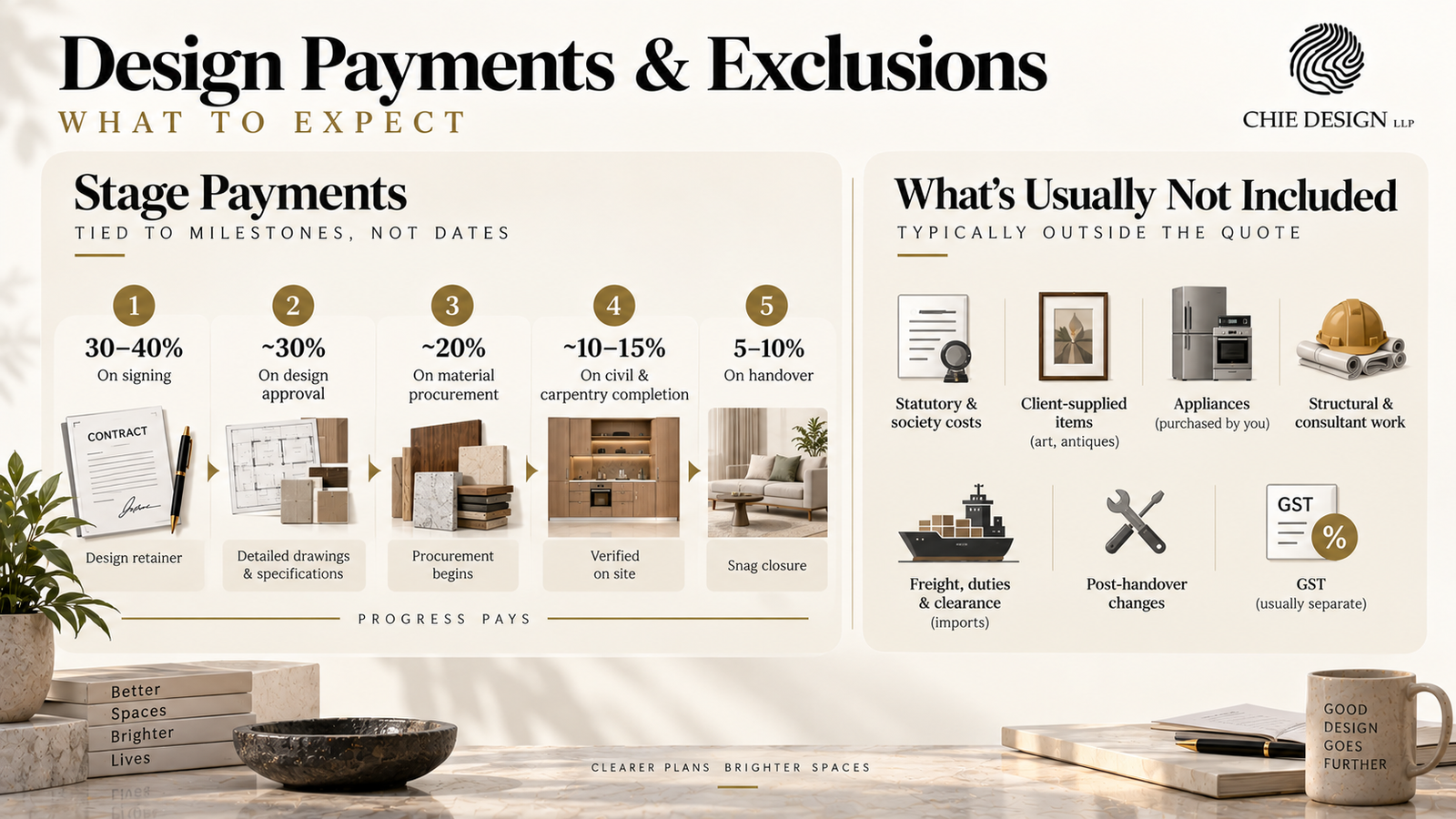
Payments are released against completed milestones rather than a calendar, which protects both sides. A common Indian residential structure runs roughly 30 to 40 per cent on signing, around 30 per cent at a mid-project milestone, 20 per cent near completion and the remainder on handover.
Milestones, not dates
The important word there is milestone. A payment tied to “week eight” pays for time. A payment tied to “carpentry installed and inspected” pays for progress, and only one of those gives you leverage if a project slows.
A workable schedule
- On signing: the design retainer, covering survey, concept and initial drawings.
- On design approval: release for detailed drawings, specifications and procurement planning.
- On material procurement: the largest single tranche, because this is where cash actually leaves.
- On civil and carpentry completion: verified on site, not on a call.
- On handover and snag closure: final retention, typically 5 to 10 per cent.
Why the retention matters
Hold that last tranche. It is the only practical mechanism for getting a snag list closed promptly, and a studio confident in its finishing will not object to it.
If you are at the point of comparing proposals, our luxury residential design page sets out how scope and stages are defined before any commercial discussion begins.
What sits outside the quote?
More than most clients expect, and almost all of it for defensible reasons. A design fee buys design and its execution. It does not usually buy the following.
- Statutory and society costs: association deposits, permissions, and any municipal approvals.
- Client-supplied items: art, antiques, and anything sourced independently.
- Appliance packages: frequently specified by the studio but purchased directly by the client.
- Structural and consultant work: structural engineering, HVAC design, and specialist acoustics.
- Freight, duties and clearance on imports: significant on European furniture and stone.
- Post-handover changes: anything requested after sign-off.
- GST: quoted separately unless the proposal explicitly states otherwise.
The import line, which surprises people most
A documented fee structure and cost breakdown is the normal way Indian practices set this out, and the useful question is not whether these items are excluded but whether they have been estimated for you anyway.
A studio that hands you an exclusions list with indicative numbers against it is doing the job properly. One that hands you a clean total with no exclusions has either absorbed the risk or has not thought about it yet.
What makes a Mumbai quote higher than a comparable one
City costs, mostly, and they are real. Mumbai carries the highest material, labour and logistics costs in the country, and site access alone can add meaningfully to a project in a South Mumbai building with a single service lift and restricted delivery windows.
The four variables that move the number
| Variable | Low end | High end |
| Joinery specification | Laminate and standard hardware | Veneer, lacquer, imported hardware |
| Imported proportion | Locally sourced throughout | Stone, furniture and fittings imported |
| Furniture approach | Curated from available ranges | Bespoke to drawing |
| Site supervision | Weekly visits | Daily presence and documentation |
A Luxury Interior designer in Mumbai quoting weekly supervision and one quoting daily supervision are selling different products, and that difference rarely appears anywhere on the first page of a proposal.
Questions to ask before signing
- Which fee model is this, and what happens to the fee if scope grows?
- Can I see the exclusions list with indicative numbers against each line?
- Are payments tied to milestones or to dates, and who verifies a milestone?
- What retention is held, and what closes it?
- Is the design fee separate from execution, or absorbed into a turnkey total?
- How many concept options do I get, and what does a further round cost?
On that last question, Chie Design presents three design concepts for every room or space, and further concepts carry no additional charge. Ask any studio the same question, because the answer tells you how they treat a client who changes their mind.
Wrapping up
A luxury interior proposal in Mumbai is really three documents: a fee model, a payment schedule and an exclusions list. Read them in that order and in that spirit, and the commercial side of the project stops being the part that goes wrong. Compare headline totals without them and you are comparing two numbers that were never measuring the same house.
Chie Design issues a scope document and an exclusions list alongside every luxury residential proposal, so the number a client sees at the start is the number they can plan against. Stage payments are tied to verified milestones rather than dates, and the retention structure stays in place until the snag list is signed off.
If you are reviewing proposals for a Mumbai residence, ask each studio for its exclusions list before comparing totals. Talk to Chie Design about your project and get a scope and fee structure you can actually hold side by side.
FAQs
What percentage do luxury interior designers charge in Mumbai?
Typically 8 to 15 per cent of total project cost for residential work, with established studios at the higher end. Some charge per square foot or a fixed fee instead, depending on how well defined the scope is when the proposal is made.
Is GST included in an interior design quote?
Usually not. Most proposals quote before GST and state it separately. Always confirm, since on a project running into crores the difference materially changes what you need to budget.
What is a normal advance payment for an interior project?
Around 30 to 40 per cent on signing is standard in Indian residential practice, covering design work and initial procurement. Anything substantially above that without a corresponding deliverable is worth questioning.
Should I hold a retention amount until handover?
Yes. A retention of 5 to 10 per cent released only on snag closure is normal practice and is the most effective way to ensure finishing items are completed rather than deferred.
Are imported materials included in the quoted cost?
The material usually is, but freight, customs duty and clearance often are not. Ask for these to be estimated separately, as they can add significantly to European stone, hardware and furniture orders.
When should I expect a detailed estimate?
After the 3D views are approved rather than at brief stage. An estimate produced before the design is settled is an indication of order of magnitude, not a number you can hold anyone to.